A smart digital platform that uses the internet of things (IoT), manufacturing execution system (MES), artificial intelligence, digital twins, big data and user interface applications to provide end-to-end solutions and modular applications.
Bilkent Cyberpark, H Blok, 1.Kat No: 13-14, TR-06800 Bilkent, Ankara Türkiye
TEKNOPAR Merkez Yerleşkesi Uzay ve Havacılık İhtisas O.S.B, G3 Caddesi No:9 06980 Kahramankazan / Ankara
tia@teknopar.com.tr
+90 312 395 99 07
+90 549 548 38 47


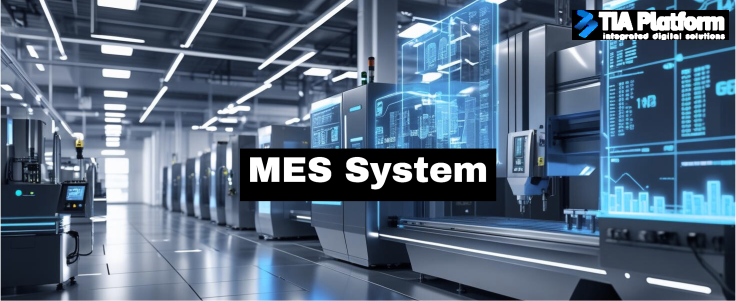
In today’s competitive manufacturing environment, businesses are engaged in a continuous transformation process to enhance efficiency and respond to customer demands more rapidly. Within these dynamic and ever-evolving conditions, the Manufacturing Execution System (MES) provides a powerful solution for enterprises.
Positioned at the core of digitalization and Industry 4.0, MES is more than just software; it is an integrated management platform that delivers end-to-end visibility of production processes, optimizes operations through real-time data, and supports strategic decision-making. As a result, businesses can achieve operational excellence while strengthening their competitive advantage.
The acronym MES stands for Manufacturing Execution System, which in Turkish is referred to as Üretim Yürütme Sistemi or Üretim Yönetim Sistemi. In simple terms, MES is a smart factory solution designed to monitor, manage, and optimize the entire production process—from raw materials to finished products.
To provide the most comprehensive answer to the question “What is MES?”: it is a production monitoring platform that collects and analyzes real-time data in manufacturing plants, enabling managers to make more informed decisions.
The primary reason MES is considered indispensable lies in its ability to ensure seamless coordination between Enterprise Resource Planning (ERP) systems, which oversee overall business management, and the machines on the shop floor. In doing so, it integrates the flow of information between “what needs to be produced” and “how it will be produced,” thereby accelerating digital transformation in manufacturing.
The use of MES is indispensable in modern factories. It is a complex, yet holistic system that meticulously controls every point of the production flow, managing all processes from a single central point. This production management system provides instant tracking of factory operations, ensuring complete visibility into every moment of the production process.
MES software forms one of the cornerstones of the Industry 4.0 concept and plays a critical role in the digital transformation of production facilities. The system establishes a reliable bridge between the production site and senior management, providing strategic advantage to businesses aiming for operational excellence.
MES capabilities span across a wide range of areas, covering every stage of production processes. Here's a breakdown of the key functions and step-by-step working method of MES:
Real-Time Data Collection
: MES systems collect real-time data from sensors, operators and other information systems through direct integration with factory equipment. This data includes critical information such as production speeds, machine status, inventory levels and quality measurements.
Data Integration and Management
: All this raw data collected is processed within the MES system and stored in a central database.
Production Planning and Work Order Management
: MES organizes work orders based on production orders from ERP and transfers this information to production units.
Process Management and Quality Control
: MES ensures effective management and control of the entire production process. With the implementation of process requirements, it is ensured that each product is produced according to specified characteristics. Additionally, quality data (measurements, inspection results) is collected during production, quality control procedures are applied, and warnings are given in case of deviations.
Performance Analysis and Reporting
: The collected data is analyzed for real-time production tracking and performance analysis reports are created. These reports provide concrete information to managers and operators to identify improvement areas.
Implementing MES software in a business provides many important advantages to businesses and gives them a competitive edge.
Production Optimization: MES improves workflows, minimizes bottlenecks in production and increases production efficiency. It shortens production cycle time by simplifying processes. In this way, products reach customers faster and overall efficiency increase occurs.
Cost Savings: Minimizes waste and scrap, eliminates unnecessary operations and lowers operating and setup costs by optimizing resource use.
Quality Control and Improvement: It reduces product defects and increases customer satisfaction by enabling instant detection and correction of errors during production.
Inventory Optimization: Through real-time inventory tracking, it reduces the need for "just-in-case" inventory, optimizes stock levels and improves material flow.
Paperless Production: It eliminates possible errors and losses in data records made on paper.
Better Decision Making: It offers the opportunity to track developments in the production line instantly. In this way, detailed analyses can be made through the data obtained and immediate intervention can be made to product-related issues.
Increasing Resource and Equipment Usage: It helps optimize machine usage and OEE analysis rates by providing information about machine performance, availability and maintenance needs ( https://tia-platform.com/tr/blog/oee-ooe-ve-teep-nedir ).
MES data includes comprehensive information sets collected from every stage of production processes. This data is of critical importance for businesses to analyze production performance and identify improvement areas:
Production Data: Produced product quantities, production speeds, cycle times and production plan compliance data
Machine Data: Machine status, operating times, downtime reasons, performance metrics and maintenance history
Quality Data: Product quality measurements, error rates, rework data and quality control results
Operator Data: Personnel performance, task assignments, training status and workforce efficiency
Inventory Data: Raw material consumption, semi-finished product status, finished product stocks and material flow information
Energy Data: Machine and line-based energy consumption, power factor and energy efficiency metrics
MES system adopts a multi-dimensional approach to increase production efficiency. This approach provides improvements at both operational and strategic levels:
Real-Time Monitoring: MES tracks production processes instantly, providing the opportunity to detect problems early and intervene quickly. In this way, production interruptions are minimized.
Bottleneck Analysis: The system automatically detects bottlenecks in the production line and offers improvement suggestions in these areas.
OEE Optimization: MES continuously monitors Overall Equipment Effectiveness (OEE) metrics, optimizing machine availability, performance rate and quality rate.
Resource Planning: The system uses intelligent planning algorithms to use available resources most efficiently.
Continuous Improvement: Continuous improvement opportunities are identified and implemented through analysis of collected data.
MES CNC integration is the key to precise and efficient production in modern production facilities. The integration established between CNC machines and MES system provides groundbreaking benefits in production processes:
CNC Machine Monitoring: MES system continuously monitors machine status, production progress and performance metrics by receiving real-time data from CNC machines.
Automatic Data Collection: Thanks to CNC production tracking, manual data entry is eliminated and error risk is minimized. Machine data is automatically transferred to the MES system.
Work Order Management: MES can send work orders directly to CNC machines and automatically update production programs.
Tool Management: The status, usage times and change times of CNC tools are tracked by the MES system.
Quality Control: Measurement data from CNC machines is analyzed by the MES system and compliance with quality standards is checked.
Predictive Maintenance: Through analysis of machine data, maintenance needs are predicted in advance and planned maintenance programs are created.
MES systems are widely used in sectors that require complex production processes and high quality standards and similar sectors with tracking difficulties. Here are some examples:
Aerospace and Defense Industry: It manages complex assembly processes, compliance with strict regulations and high quality control levels.
Automotive Sector: It plays a critical role in managing complex assembly processes and supply chain.
Food and Beverage Industry: It provides recipe management, batch tracking, allergen control and compliance with food safety regulations.
Pharmaceutical and Medical Device Manufacturing: Pharmaceutical and Medical Device Manufacturing: Essential for strict traceability, documentation, and regulatory compliance.
Electronics Industry: It provides component tracking, equipment performance monitoring and real-time visibility into production processes.
Consumer Products: It helps optimize production efficiency, manage packaging variations and coordinate multiple production lines.
Although implementing an MES system offers great benefits, it can also bring some challenges. However, these challenges can be overcome with the right approach:
Complex Implementation Process: MES projects can be complex and time-consuming, requiring significant planning, configuration and integration with existing systems. For such situations, it is very important to clarify targets and correctly analyze the business needs.
Data Integration Challenges: Ensuring that MES exchanges data seamlessly with other systems like ERP can be challenging. As a solution, use common interface standards for integration and conduct detailed planning to ensure data consistency.
Change Management: Transitioning to a new system can change business processes, workflows and employee roles, so resistance to the new system may be encountered within the team. To counter these issues, organize comprehensive training and communication programs, clearly explain the benefits of MES to employees and ensure their participation.
Financial Difficulties: MES investment can be costly initially and benefits may emerge over time. As a solution, you can carefully calculate the potential return on investment and make this process beneficial for your company with small steps through pilot applications.
Data Security: Since MES systems process sensitive production data, protecting them against cyber attacks is of critical importance. The best solution against such problems is to take solid security measures and give cybersecurity the same value as the transformation process.
The integration of MES and ERP is a critical component of digital transformation. Although they have different areas of focus, when used together these two systems provide significant strategic advantages for businesses.”
• While ERP knows "why" the work is done (planning, finance, sales), MES knows "how" the work is done (production operations, real-time tracking).
• When integrated, production plans are created more accurately, stock levels are optimized and customer orders are met faster.
With the Smart Factory concept, the future of MES system is being shaped by developing technologies.
Artificial Intelligence: MES systems will make production processes intelligent and predictable by using artificial intelligence and machine learning algorithms. The ability to detect unusual situations, predict production results and suggest process improvements will increase.
Industrial Internet of Things (IIoT) Integration: Real-time data from machines and sensors will be more tightly integrated with MES, improving visibility, efficiency and predictive maintenance.
Cloud-Based MES: The adoption of cloud-based MES software solutions will increase due to providing scalability, flexibility, low infrastructure costs and easy access to data from different locations.
Big Data Analytics: MES has the ability to process large data sets from the production floor and perform comprehensive analyses.
The Manufacturing Execution System (MES) has become a critical requirement for businesses in today’s rapidly evolving and highly competitive market environment. With its capability to collect and analyze real-time data, MES enables the optimization of production processes, enhances efficiency, reduces costs, and ensures continuous improvement in product quality.
In the journey of digital manufacturing transformation, MES is not merely an operational tool but a strategic partner that empowers enterprises with sustainable competitive advantage.