
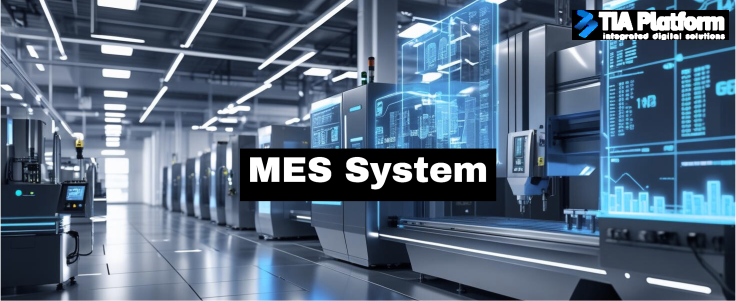
In today’s competitive manufacturing environment, businesses are engaged in a continuous transformation process to enhance efficiency and respond to customer demands more rapidly. Within these dynamic and ever-evolving conditions, the Manufacturing Execution System (MES) provides a powerful solution for enterprises.
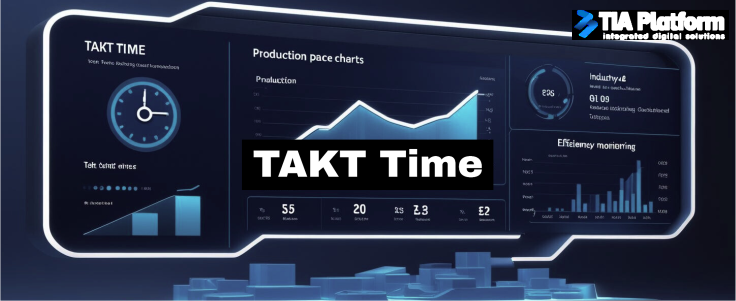
TAKT Time is a key production management indicator that expresses the production pace required on the shop floor to meet customer demand. In other words, the production process is synchronized with customer requirements. For example, if customer demand for a product is 60 units per hour, the production line must be planned to produce one unit every minute. This calculation directly aligns production capacity with customer demand.
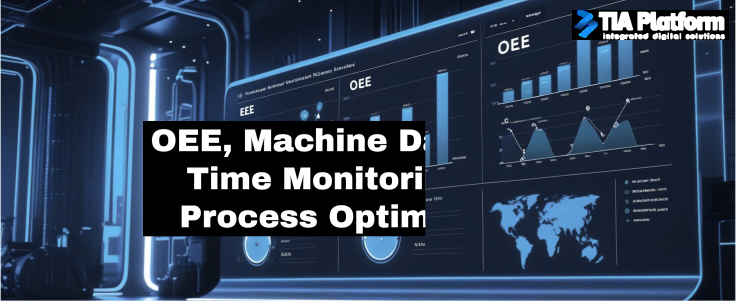
With the continuous advancement of technology, the efficiency of machines and equipment used in production systems is also steadily increasing. However, ensuring the sustainability of this efficiency requires accurate monitoring and systematic improvement. At this point, the question “What is machine efficiency and how is it measured?” becomes crucial.

In today's industrial production environment, it is critically important for businesses to optimize the efficiency of their production processes to achieve a sustainable competitive advantage. In this optimization process, OEE (Overall Equipment Effectiveness), OOE (Overall Operations Effectiveness), and TEEP (Total Effective Equipment Performance) stand out as key metrics used in measuring and analyzing production efficiency. These three fundamental metrics help to measure production processes, identify bottlenecks, determine operational losses, and make capacity management more effective.

The increase in the world population and the rapid depletion of natural resources have made innovative approaches in production and energy consumption indispensable. The growing energy demand driven by industrialization puts increasing pressure on natural resources, leading to global challenges such as climate change, loss of biodiversity, and resource depletion. While traditional production methods exacerbate these issues, the concepts of sustainable production and energy efficiency emerge as key solutions to mitigate their impacts. Sustainable production and energy efficiency not only reduce environmental impacts but also provide economic and social benefits. These approaches within the industry enhance operational efficiency and support long-term economic success. Moreover, investments in innovative technologies enable companies to adopt an environmentally friendly image and better meet consumer expectations.

Carbon footprint refers to the total amount of greenhouse gases emitted into the atmosphere by individuals, institutions, or production processes. It is divided into two main categories:

TIA Guard detects collisions and impacts during the machine's operating process. It is designed according to industrial environmental standards, making it resistant to water, machine oil, chemicals, and dust particles. TIA Guard has a built-in vibration sensor with a wide measurement range to prevent high costs resulting from collisions and crashes. This sensor can continuously monitor the vibration values at the point where it is installed in real-time. When the threshold value is exceeded, TIA Guard quickly intervenes by either stopping the machine or placing it in standby mode. It uses the CANBUS communication protocol to quickly detect collisions and impacts. Additionally, the vibration data collected in real-time is transmitted to the user interfaces using the MQTT protocol.

In industry and manufacturing, industrial robots are commonly used. They are preferred for increasing production capacity and efficiency in repetitive tasks that require speed, high precision, and may pose risks to human life. According to ISO 8373 Standard, the classification of industrial robots is as follows:

ROS (Robot Operating System) is an open-source software platform used to develop robotic applications. ROS is not an actual operating system but functions like one, managing packages between different hardware components and software modules. ROS facilitates receiving data from sensors, processing this data, and controlling robots based on the processed data.

Digital transformation is one of the most critical ways to enhance the competitive strength of industrial enterprises and transition to a sustainable production structure. In this context, the digital transformation supports offered by the Ministry of Industry and Technology and KOSGEB provide significant contributions to the digitalization processes of businesses. The TIA Platform product family that can benefit from these supports is listed below.

Computer Vision (CV) is an area of artificial intelligence that gives computers the ability to extract meaningful information from digital images. Using advanced technologies such as machine learning and deep neural networks, machines are enabled to mimic the human eye and brain. The main purpose of computer vision is to analyze data in digital images to identify objects, analyze movements, interpret complex scenes, improve images, and create 3D models from 2D images. This technology also has a wide range of uses in the industrial field. Quality control, inspection, automation, safety systems, robotic/machine vision, autonomous vehicles are involved in many application areas, such as efficiency improvement, smart factories and integrated systems. Computer vision plays a critical role in the industry to improve quality, speed up production processes, ensure safety and optimize operations. The effective use of this technology makes significant contributions to companies’ competitiveness and lower costs.

Digital twin technology enables processes in production and industry to become more transparent, efficient and optimised. While increasing the performance of production lines, it reduces costs with applications such as predictive maintenance and process optimization. This technology is considered a critical tool that will be at the center of industrial automation and digital transformation projects in the future. Although various definitions have been made for digital twins, the basis of the definitions is the same. Some of these definitions:

The Industrial Internet of Things (IIoT) applies Internet of Things (IoT) technology to industrial settings. It includes sensors, equipment communication systems, automation tools, and analytical platforms used to control and improve operations. The system collects, processes, and analyzes data, then provides valuable, real-time information to managers, operators, and other users. Advanced IIoT applications can develop predictive solutions and even allow machines to operate with minimal human input. By using artificial intelligence, machine learning, and other software tools, IIoT creates a highly efficient cyber-physical system that outperforms traditional manufacturing monitoring methods.

We are pleased to announce that TEKNOPAR was a sponsor at the Science Academy Artificial Intelligence Learning Summer School, held at TED University in Ankara from July 1-4, organized by TED University and Middle East Technical University.
A smart digital platform that uses the internet of things (IoT), manufacturing execution system (MES), artificial intelligence, digital twins, big data and user interface applications to provide end-to-end solutions and modular applications.
Bilkent Cyberpark, H Blok, 1.Kat No: 13-14, TR-06800 Bilkent, Ankara Türkiye
TEKNOPAR Merkez Yerleşkesi Uzay ve Havacılık İhtisas O.S.B, G3 Caddesi No:9 06980 Kahramankazan / Ankara
tia@teknopar.com.tr
+90 312 395 99 07
+90 549 548 38 47


